One of the more subtle anxieties I carry around AI right now is not about what the models can do. It is about what using them does to us. The default design logic of these systems is optimized for task completion: you ask, it answers, you move on. The intellectual work of grappling with an idea, turning it over, connecting it to something you read three years ago, sitting with the discomfort of not quite understanding something yet, all of that gets quietly outsourced. This is cognitive offloading, and it is the default setting.
The question that motivated my final project for AI & Humanities at the University of Chicago was simpler and more urgent: can we build a system that does the opposite? Can AI be designed to extend your thinking rather than replace it? The result is CoIntel, short for Collective Intelligence, an AI operating system built entirely around that premise.
The Philosophical Foundations
Before describing the system, it helps to describe the ideas behind it. These are not just inspirations. They are the design constraints.
Heidegger and McLuhan converge on a point that should make any honest technologist uncomfortable. In The Question Concerning Technology, Heidegger argues that technology is a mode of revealing: it discloses the world in a particular way, shaping what we see and what we miss. McLuhan goes further and calls technology both an amplification and an amputation. The car amplifies our will to move through space while atrophying our capacity to walk and notice things along the way. The clock, invented to serve human scheduling, now largely runs human life. We think we control technologies; technologies have a way of returning the favor. If we do not design AI systems with this dynamic clearly in mind, we will build very powerful tools for making ourselves less capable.
Mark Weiser, the late CTO of XEROX PARC, offers a corrective. PARC invented the GUI, Ethernet, the mouse, and object-oriented programming, and Weiser's philosophical touchstones for all of it were Merleau-Ponty, Polanyi, and Heidegger. His idea of calm technology is remarkably specific: "The most profound technologies are those that disappear. They weave themselves into the fabric of everyday life until they are indistinguishable from it." The design goal is not engagement. It is not time-on-app or notification frequency. It is a symbiotic extension of the user's will, present when needed and invisible otherwise.
David Chalmers' Extended Mind Hypothesis offers the cognitive science frame. Cognition need not be confined to the brain. Notebooks, iPhones, and now AI systems all function as genuine extensions of our cognitive processes. The Google Effect is a live example: knowing that a fact is searchable changes how the brain stores it. The question is whether AI can serve as a cognitive prosthetic that amplifies rather than supplants, integrating with memory and reasoning rather than replacing them.
Finally, Jean Piaget: we form new knowledge by attaching it to existing knowledge. New ideas need anchor points. A system that forces every new piece of information into contact with what you already know is not just convenient; it is structurally aligned with how human understanding actually develops.
What CoIntel Does
CoIntel is a personally curated, LLM-maintained knowledge base. The goal is to give you a thinking companion with full context over everything you have ever fed it, able to surface connections across your entire reading and reasoning history, and willing to push back. The dialectic is Hegel in practice: the machine as your prosthetic antithesis.
Creativity, at its core, is intentional novel synthesis. I believe it can be promoted in two ways: visually and dialectically. The visual component is an embedded concept graph, inspired by Obsidian and Research Rabbit, that maps your knowledge as a living network. The dialectical component is an agent that reasons through that network with you, not just retrieving what you know but challenging it.
The Ingestion Pipeline
- Ingest. Drop a PDF, paste a URL, or write a note directly into the system.
- Summarize. An agent reads the raw document and writes a wiki entry: a summary, key claims, and wiki-links to existing concepts in your knowledge base.
- Connect. The agent updates or creates concept and person pages, attaching the new source via backlinks. This is the Piagetian move: new knowledge fastens to existing schemas.
- Embed. Those connections are projected onto an interactive knowledge graph.
- Dialogue. You query the agent via chat. It retrieves via the graph, traces backlinks (a hyper-specialized form of RAG), and responds not just with answers but with counter-arguments, surfacing tensions in your own thinking.
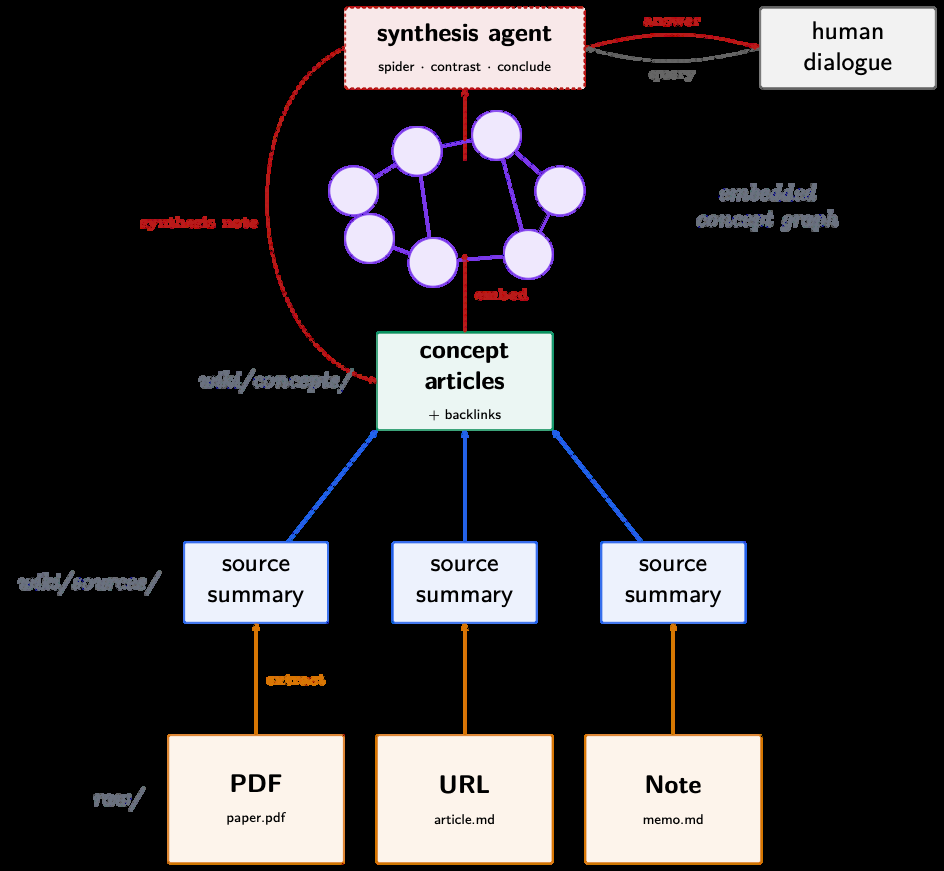
The markdown system the agent reasons from is doing something specific: it forces the model to evaluate the quality of its own connections, and to frame its outputs as genuine dialectical moves rather than information retrieval. The system is not designed to give you the answer. It is designed to make you reach further for it.
The System in Practice
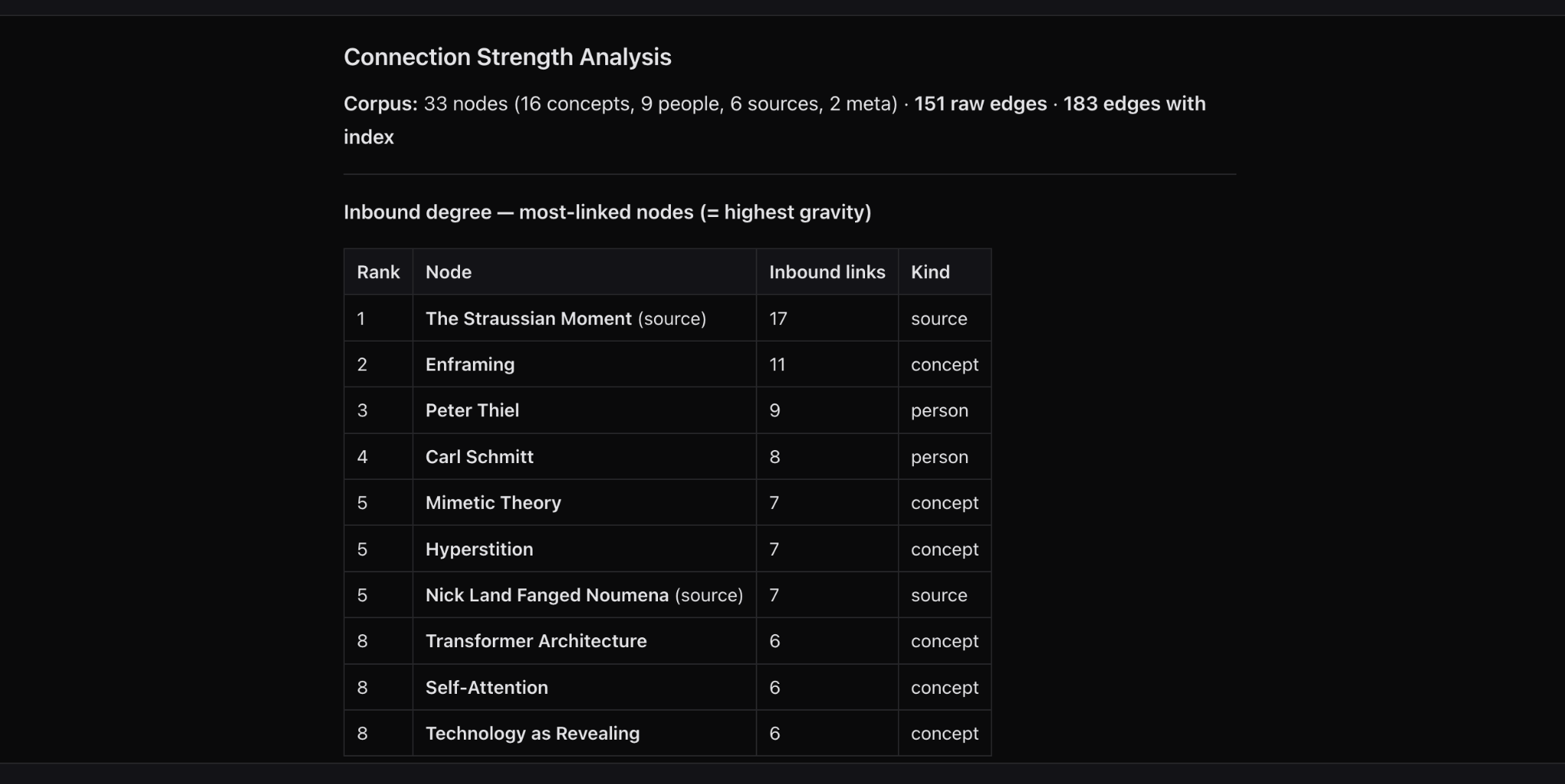
The meta-analyze feature is a good illustration. You ask CoIntel to analyze the strength of the connections in your knowledge base. It runs across the entire corpus, maps inbound degree by node, and renders the results: which concepts have the highest gravity, meaning which ideas are most densely connected to everything else you have read and thought about.
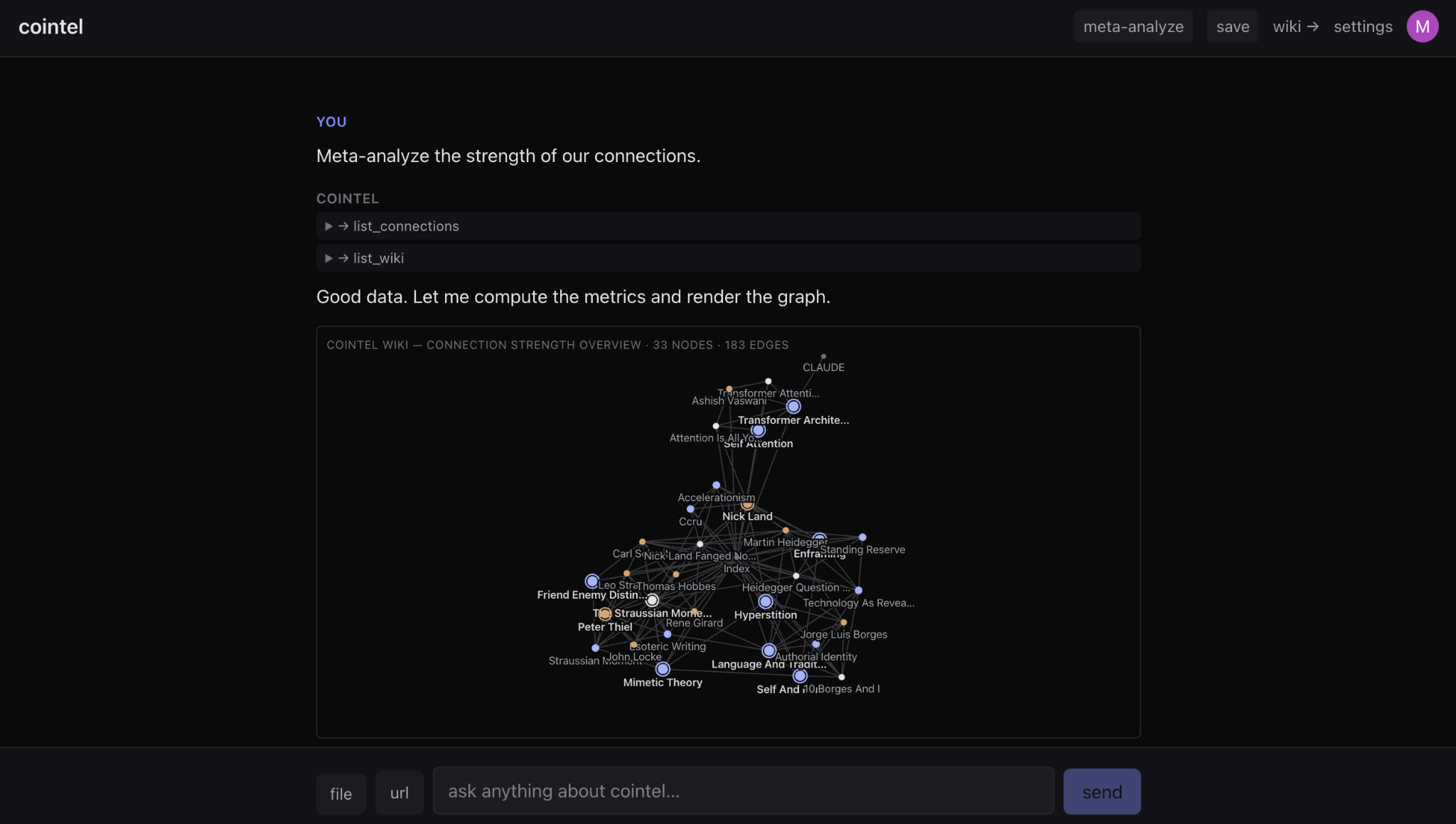
In my own corpus, the results surprised me. The Straussian Moment was the most-linked source, with 17 inbound connections. Enframing (Heidegger's concept of technological disclosure) was the most-linked concept node, with 11. Peter Thiel and Carl Schmitt followed, then Mimetic Theory and Hyperstition. The graph is a portrait of my reading as a network, and it reveals things about how I think that I would not have been able to articulate from the inside.
How It Compares to NotebookLM
Google's NotebookLM is the most obvious point of comparison. It is genuinely good at what it does. But what it does is fundamentally different from what CoIntel is trying to do.
| Dimension | NotebookLM | CoIntel |
|---|---|---|
| Grounding | Cites passages from uploaded sources. Strongly bound to the notebook. | Cites markdown wiki nodes and raw sources. Can search the whole corpus, fetch new URLs mid-answer, and pull PDF text on demand. |
| Synthesis | Strong at standard RAG queries. Synthesis is ephemeral: it lives in a chat turn or generated note. | Synthesis is materialized as wiki nodes with backlinks. Each answer potentially leaves the knowledge base smarter than it found it. |
| Meta-analysis | Limited to fixed renderers: briefing doc, study guide, FAQ, mind map. | Open-ended: the agent can grep for patterns across the wiki, count backlinks, find orphan nodes, diff sources against concepts, and render charts. |
| Multi-hop reasoning | Hops within indexed sources. | Hops across raw files, the wiki, the live web, and generated outputs. Can chain "find the gap, fetch new source, update wiki" in a single turn. |
| Longitudinal memory | Each notebook is a fresh context. No record of how understanding evolved. | The wiki accretes. Concept nodes get edited over time. The git history, if enabled, is a literal record of how the model of the domain changed. |
The core distinction: NotebookLM is knowledge retrieval. It produces well-cited responses and does it well. CoIntel is a reasoning agent where meaningful answers get logged into the ontology of the system itself. Whereas NotebookLM optimizes for simple retrieval, CoIntel maintains reasoning continuity across a connected, evolving knowledge corpus.
Reflections on Using It
It can debate. It finds connections, recognizes contradictions in dense texts, engages with Borges and Heidegger with the taste and judgment of an academic and a high degree of epistemic humility. It is somehow aware that some of its connections and intuitions are stronger than others, and it navigates this well.
The meta-analysis feature has been particularly valuable for critique. When the system evaluates the strength of its own connections, you can spot where its reasoning is weakest and push back. After that feedback, the agent can rewrite and update the wiki, strengthening its connections over time. This is a rough, informal version of RLHF: human critique folded back into the knowledge base. As context grows, and as the underlying models improve, the connections only compound.
One practical note worth mentioning: the base model is entirely swappable. The system runs on Anthropic currently, but OpenAI or an open-source model from Allen AI would slot in cleanly. The architecture is agnostic to the underlying intelligence.
On Context and Future Directions
The most interesting technical question going forward is coherence at scale. Claude's context window is theoretically around one million tokens, roughly 350,000 pages of a standard novel. But in practice, attention can degrade well before that. The markdown file system approach, popularized by open-source projects like Openclaw, has proven that you can be very compute-efficient if the agent is pulling context from a well-organized structure rather than loading everything at once. This keeps the system tractable even as the corpus grows.
Further work I am considering: a soul.md document for the system, similar in spirit to Anthropic's model spec, to concentrate the agent's reasoning style and epistemic values. Some fine-tuning might be interesting, though I suspect prompt engineering and context engineering will carry further than expected, and fine-tuning risks narrowing the scope of the model's reasoning in ways that are hard to detect.
The Larger Question
Herbert Simon, the late University of Chicago alum and Nobel Laureate who gave us bounded rationality, put it well: "A wealth of information creates a poverty of attention." This is the environment we are navigating. Between AI-generated slop engineered for engagement, products explicitly marketed as cheating tools, and ads embedded in model outputs, the commercial incentive structure is uniformly pointed in the wrong direction.
Humans are evolutionarily wired to prefer what is quick and easy. Technology corporations have fiduciary obligations to serve that preference on a silver platter. CoIntel is, admittedly, idealistic. It requires effort. It asks you to think rather than outsource your thinking. That is a hard sell in the current attention economy.
But if we accept the premise that how we design human-AI interaction is a determining factor in the kind of future we inhabit, then building systems aligned with genuine human flourishing rather than engagement metrics starts to look less like idealism and more like necessity. Mike Judge's 2006 film Idiocracy sketched one possible trajectory. A platform that by design forces you to confront and expand your own ideas might be one small way to avoid it.
We made sand think. The question is whether we are thoughtful enough about how we use it.