"Progress" is a language game. The word does different work for different people: everyone claims to want it, or to be advancing it in some capacity, but almost no one means the same thing by it. Most definitions function as moral placeholders. They let people and institutions gesture at progress without committing to a claim precise enough to be checked, a kind of nebulous virtue signaling dressed up as conviction. This essay starts from the premise, inspired by Patrick Collison and the progress studies literature (see References), that we need an actual science of progress: a discipline for defining what progress materially means, and for telling real progress apart from progress that is illusory, or achieved irresponsibly. That need is sharper now, in the AI era, than it has been before.
The immediate provocation is the current Cambrian explosion of intelligence: capability compounding at extraordinary speed, but in narrow, spiky domains. That is not automatically the same thing as progress. Venture capital's working assumption is that raw capability growth converts into a materially better world more or less by default. This essay's position is that it can, and likely will, but only under specific conditions where deliberate institutional focus & capital deployment strategies are taken, ensuring that the impersonal forces of capitalism are maximally aligned with human flourishing as we quickly usher in the AGI and post-AGI era.
Outline
- Define progress. What it materially means to progress, and where the word breaks down into different, sometimes incompatible claims.
- Real vs. illusory progress. Under what conditions spiky capability growth in a domain fails to translate into a materially better world, and how to tell the difference from the outside. Includes a critique of why neoclassical economic models (GDP and productivity statistics chief among them) systematically misaccount for materialized progress.
- Evaluate and benchmark it. Ways of measuring progress rather than asserting it.
- Invest toward a progress-oriented future. What needs to get built, and where capital should flow if it is actually optimizing for progress rather than just capability.
- A guide to responsible innovation. Practical principles for building and investing in a way that compounds into real progress rather than narrow or illusory gains.
This is the idée fixe for why Theseus exists at all: an organization built to accelerate civilizational Progress, operating through independent branches on independent timescales. Theseus Capital is where that view is put into practice first: cultivating the capital, the people, and the ideas needed to actually build toward Progress, not just theorize about it.
Storyboard: Sourced Propositions
The essay is being assembled from source material as it comes in. Each proposition below is a discrete node: a claim drawn from a specific source, plus a note on where it slots into the outline above. Over time these should compose into a working ontology of the argument rather than a loose reading list.
Techno-humanism as the moral floor for what counts as progress
Jason Crawford, “Announcing The Techno-Humanist Manifesto,” Roots of Progress newsletter, July 8, 2024. newsletter.rootsofprogress.org
Crawford's manifesto argues for techno-humanism: the view that science, technology, and industry are valuable because they promote human flourishing, not because growth or capability are goods on their own terms. His formulation is a causal claim rather than a synonym: material progress leads to human progress. It does not simply constitute it. The book is organized in three parts. The value of progress treats industrial civilization as an expansion of human agency and mastery over nature, and defines well-being as active goal-pursuit rather than passive contentment. The future of progress asks whether humanity's problem-solving capacity can keep pace with the rate of change it is generating, and gestures at what Crawford calls a fourth age of civilization, marked by expanded control over natural systems. The culture of progress asks why historical optimism receded and what a moral vision of progress, with real aspirational and heroic archetypes, would look like now.
The key move for this essay is the causal wedge Crawford drives between material change and human flourishing. That wedge is exactly the distinction "progress" collapses in ordinary usage, and exactly the one venture capital's default assumption about AI skips past: capability growth is treated as though it converts to a better world automatically, when on Crawford's own terms that conversion is conditional and has to be argued for, not assumed.
Progress splits into three strands that do not move together automatically
Jason Crawford, “What Is Progress?,” Roots of Progress blog, March 9, 2024. blog.rootsofprogress.org
This is the earlier post that Proposition I's manifesto builds out into a book, and it does the more basic definitional work. Crawford breaks unqualified "progress" into three strands: material progress (expanded knowledge, better theories, better inventions, more production and wealth), social or moral progress (decline of violence, the end of slavery, the spread of equal rights, the move toward representative government), and what he calls ultimate progress, meaning actual advancement toward human well-being, health, and happiness. His claim is that the word "progress," used without qualification, only earns its meaning when all three are moving together. Material progress alone is just one input.
He is explicit that this framework is a correction, not a restatement, of the 19th-century idea of progress, which he says made two errors: treating progress as inevitable, and assuming moral progress follows automatically once material progress is underway. Crawford's version drops both assumptions. Progress, on his account, is not automatic and has to be steered, deliberately and continuously, rather than trusted to arrive as a byproduct of growth.
This sharpens Proposition I rather than repeating it. Where the manifesto gives the causal claim (material progress leads to human progress), this post gives the structure that claim has to be checked against: three separable strands, any of which can lead or lag the others. That is a direct, working definition for this essay's Section 1, and it hands Section 2 its actual test for illusory progress: a domain where the material strand is compounding while the social and human strands are flat, stalled, or moving in the opposite direction. AI's narrow, spiky capability growth is a candidate case for exactly that pattern, which is the essay's opening provocation.
The next three propositions are Crawford's 2017 trilogy on where the idea of progress actually came from, historically. They matter for this essay because they show progress was never a default human orientation. It had to be assembled out of specific, separable ingredients, which means each ingredient can also be missing.
Progress is a modern invention, not a human default
Jason Crawford, “The Idea of Progress,” Roots of Progress blog, March 23, 2017, drawing on Joel Mokyr's A Culture of Growth. blog.rootsofprogress.org
Crawford locates the origin of progress as an idea, meaning the belief that humans can and should deliberately improve the world, in the two centuries between Columbus and Newton. Before that window, most civilizations treated history as cyclical or as fixed by higher powers, and deferred to classical authorities on geography, medicine, and astronomy as essentially complete and final. What broke was that deference. Europeans began to suspect, and then to argue, that their own generation knew more than the ancients had. Mokyr's line, which Crawford quotes, is that this was "a sense that their own generation knew more and was wiser than those of previous eras."
The essay's use for this is mostly a corrective to intuition. It is tempting to treat progress as the default trajectory of any sufficiently capable civilization, something that happens unless actively blocked. Crawford's history says the opposite: progress required a specific, datable break in how people related to authority and the past, and that break did not have to happen. If it is a historically contingent achievement rather than a default state, then it can also be regionally or domain-specifically absent even while raw capability is present elsewhere, which is exactly the gap Section 2 needs to name.
Bacon's program: a multi-generation bet on a research method, made before it paid off
Jason Crawford, “The Baconian Program,” Roots of Progress blog, March 30, 2017, drawing on Joel Mokyr's A Culture of Growth. blog.rootsofprogress.org
Francis Bacon's program, as Crawford reconstructs it, was a plan for researchers to find patterns in nature through experiment rather than speculation, apply them methodically rather than by trial and error, and direct the resulting knowledge toward practical, industrial use: "knowledge is power," taken literally. Bacon articulated this roughly two centuries before the Industrial Revolution it anticipated actually arrived. Crawford's point, following Mokyr, is that Bacon's real achievement was not foresight. It was that European intellectuals kept faith with his program for two full centuries despite the promised payoff arriving far slower than advertised.
That is close to a template for what Section 4 of this essay needs: an example of capital and institutional attention being committed to a research program on the strength of its structure and method, not its near-term output, and sustained across a lag long enough that most funding models today would have abandoned it. It also raises the hard question Section 4 has to answer: what distinguishes a genuine multi-generation bet from a program that is simply never going to pay off. Bacon's case looks obviously correct in hindsight; the essay needs a way to make that judgment before the fact.
Growth also requires believing intervention in nature is virtuous, not just knowing how to do it
Jason Crawford, “The Virtuousness of Technology,” Roots of Progress blog, March 31, 2017, drawing on Joel Mokyr's A Culture of Growth. blog.rootsofprogress.org
Beyond method (Proposition IV), Crawford identifies a second, separate cultural prerequisite for growth: a society has to actually believe that manipulating the natural world is a good thing to do, not a transgression against it. Excessive reverence for nature, religious anxiety about overstepping into what belongs to higher powers, or treating nature as fundamentally beyond human comprehension, all suppress innovation regardless of how capable a society otherwise is. Crawford extends this directly to the present, arguing that some modern environmentalist attitudes reproduce the same caution Mokyr identifies as historically progress-inhibiting.
This is useful evidence for Section 5, and it cuts in an uncomfortable direction on purpose: it shows that cultural permission to build is a necessary input to progress, separate from capital, capability, or method. A guide to responsible innovation has to hold two things in tension without collapsing them: real caution about real harms, and enough cultural permission that the caution doesn't calcify into the same reflexive suspicion of intervention Mokyr is describing. That tension, not a resolution of it, is the honest content for Section 5.
The next three propositions are Crawford's 2024 newsletter series, written after the manifesto was announced. They shift from history to diagnosis: what stagnation looks like now, why it is self-perpetuating, and how to actually define and measure the thing the essay is chasing.
Stagnation is a crisis of belief as much as of output, and the two feed each other
Jason Crawford, “The Present Crisis,” Roots of Progress newsletter, July 9, 2024. newsletter.rootsofprogress.org
Crawford lays out the material case for stagnation: decades of decelerating GDP and productivity growth, no major general-purpose technology in manufacturing, construction, or energy since the 1960s, permitting timelines measured in years, and bureaucratic bottlenecks that slowed even vaccine distribution during COVID. Alongside that, he documents a cultural collapse in the belief that things are getting better at all, citing surveys where only a minority of people think the world is improving and a majority of young people describe the future as frightening. His causal claim is that the pessimism is not merely downstream of the stagnation. It is partly upstream of it: without belief that progress is achievable, societies do not make the long-horizon investments progress actually requires, which produces more stagnation, which further erodes belief.
He also stakes out the essay's actual target here, naming two failure modes he wants to avoid: naive optimism that waves away real risk, and accelerationism, which treats technological development as an impersonal process to be maximized on its own terms, independent of whether it serves human flourishing. His answer is the techno-humanism from Proposition I, positioned explicitly between the two. This gives Section 2 a named opponent. "Illusory progress," in this essay's terms, is close to what Crawford means by accelerationism: capability treated as self-justifying, decoupled from any argument that it is converting into human flourishing.
Progress becomes invisible once it succeeds, which biases how it gets measured
Jason Crawford, “Fish in Water,” Roots of Progress newsletter, July 16, 2024. newsletter.rootsofprogress.org
The metaphor: modern people are so fully immersed in industrial civilization's infrastructure and comforts that they stop perceiving it, the way a fish cannot perceive water. Progress, on Crawford's telling, is a victim of its own success. Once a problem like famine, disease, isolation, or cold is solved reliably enough, both the problem and the solution that fixed it drop out of view, and the only time the underlying system becomes visible again is when it fails: a blackout, an empty shelf, a supply-chain gap, all of which get treated as newsworthy in a way the default, working state never does. He backs this with a catalog of underappreciated recent inventions (zippers, mass-produced toothbrushes, cheap fruit and spices, dyes once reserved for royalty) to make the invisibility concrete rather than abstract.
This lands as a measurement problem, not just a mood, which is exactly what Section 3 needs. If solved problems are systematically invisible and failures are systematically salient, then any benchmark built on visible or reported signals, including news coverage, public sentiment, and some economic indicators tied to disruption, will be structurally biased toward detecting the absence of progress and against detecting its presence. That is a specific, correctable failure mode for a benchmarking methodology, not just a reason to feel more grateful.
Progress, defined structurally, is the shrinking gap between what happens to you and what you choose
Jason Crawford, “The Surrender of the Gods, Part 1,” Roots of Progress newsletter, July 23, 2024. newsletter.rootsofprogress.org
Crawford traces three regimes of human agency. Hunter-gatherers lived, in his words, at the mercy of nature: no food storage, no weather prediction, no way to prevent disease. Agricultural and pre-industrial societies gained settlement, new materials, and harnessed energy, but manufacturing stayed inconsistent, transport unreliable, and disease largely uncontrolled, what he calls "a world still ruled by the gods." The modern era adds scientific and technological mastery on top of that. His concrete evidence is mortality from pandemic disease: roughly 30 percent or more for the Black Plague, about 3 percent for the 1918 flu, about 0.3 percent for COVID, a rough three-order-of-magnitude decline used as a proxy for expanding human agency over what used to be pure chance. He also directly rebuts two standard critiques of that story, that expanded choice creates instability and that technology enslaves rather than liberates, arguing modern societies have more capacity to manage change and choice than any prior society did.
This gives the essay a structural, testable definition to set directly against the AI-capability question in the introduction: progress, on this account, is measured by how much a given change shrinks the gap between what happens to people and what they actually choose. That is a candidate metric for Section 3, applicable domain by domain: does a capability gain measurably expand the range of outcomes people can choose or avoid, or does it just produce output. It also gives Proposition I's language of "agency" a concrete historical anchor rather than leaving it as an abstraction.
Six independent domains, two centuries, the same shape: a working template for benchmarking
“The World as 100 People, Over the Last Two Centuries,” Our World in Data, by Max Roser. ourworldindata.org. Licensed CC-BY-SA.
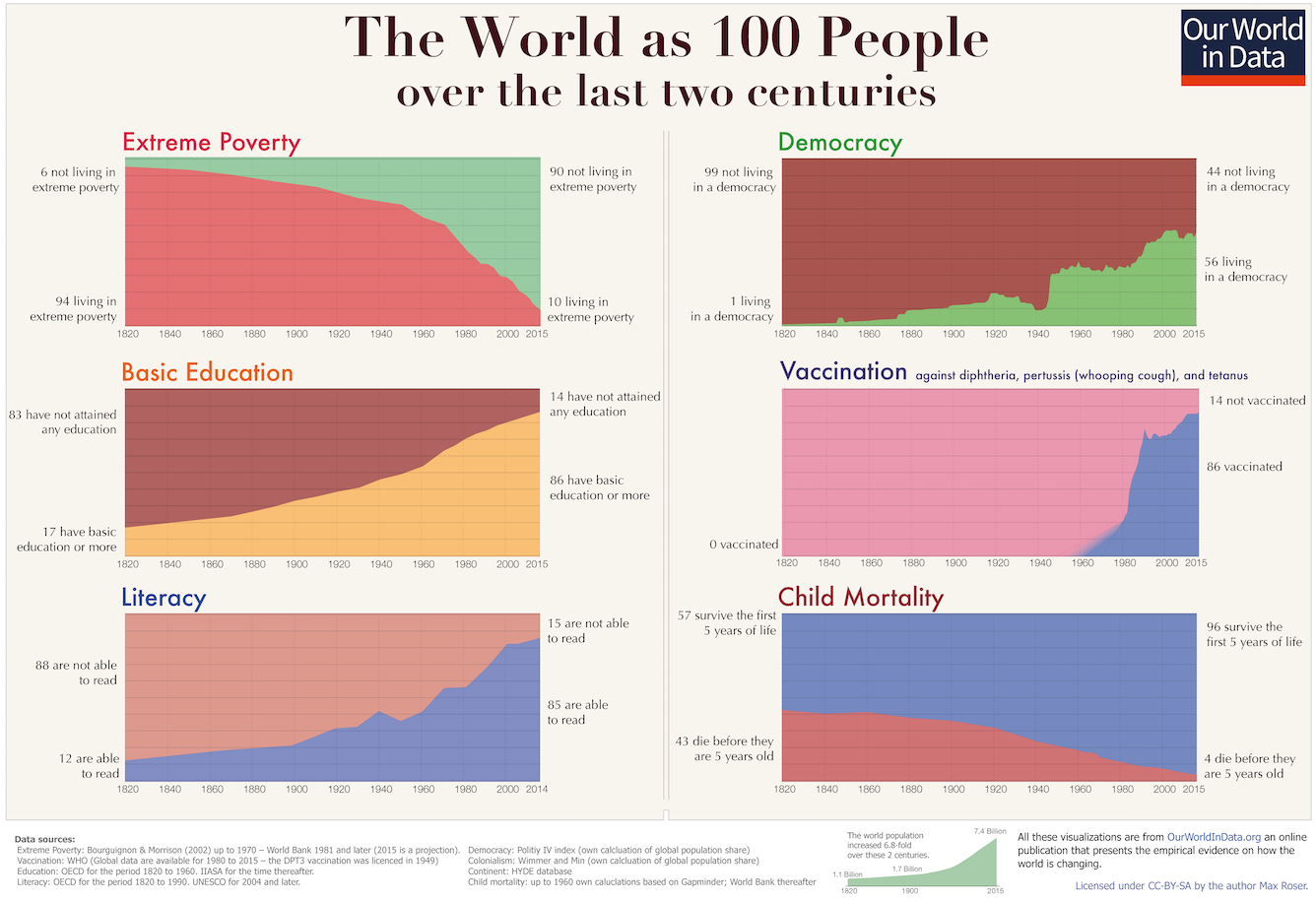
This chart runs the same 1820-to-2015 window across six independent domains, normalized to a population of 100 people so the domains are directly comparable: extreme poverty falls from 94 to 10, democracy rises from 1 in a democracy to 56, basic education from 17 to 86, vaccination against diphtheria, pertussis, and tetanus from 0 to 86, literacy from 12 to 85, and child mortality falls from 43 deaths before age five to 4. The underlying sources are independent of each other and of Crawford's work: Bourguignon and Morrison plus World Bank data for poverty, the Polity IV index for democracy, OECD and IIASA and UNESCO for education and literacy, WHO for vaccination, and Gapminder plus World Bank for child mortality.
What makes this useful for Section 3 rather than just illustrative is that it is convergent evidence, not a single narrative. Six domains, six separate data-collection traditions, one shape. That is close to what a real benchmark for progress needs to look like: not one indicator asserted to stand for the whole, but multiple independent measures of Proposition VIII's agency-expansion claim (poverty, health, and violence all track chance and necessity receding) moving together over the same long window. It also gives Section 3 a concrete counter-example to Proposition VII's invisibility bias: these are exactly the kind of slow, undramatic, decade-over-decade gains that never make the news on any given day, which is precisely why they need to be tracked deliberately rather than read off public sentiment or headlines.
References
- Patrick Collison & Tyler Cowen, “We Need a New Science of Progress,” The Atlantic, July 30, 2019. Coined "progress studies" as a proposed field. The founding provocation this outline is responding to.
- Jason Crawford, “Announcing The Techno-Humanist Manifesto,” Roots of Progress newsletter, July 8, 2024. See Proposition I above. Supplies the causal, humanist definition of progress the essay builds on.
- Jason Crawford, “What Is Progress?,” Roots of Progress blog, March 9, 2024. See Proposition II above. Splits progress into material, social, and human strands and supplies the essay's working test for illusory progress.
- Jason Crawford, “The Idea of Progress,” Roots of Progress blog, March 23, 2017 (via Joel Mokyr, A Culture of Growth). See Proposition III above. Dates progress-as-belief to the Columbus–Newton window; establishes it as historically contingent, not a default.
- Jason Crawford, “The Baconian Program,” Roots of Progress blog, March 30, 2017 (via Joel Mokyr, A Culture of Growth). See Proposition IV above. Template for a multi-generation, method-driven bet sustained ahead of material payoff.
- Jason Crawford, “The Virtuousness of Technology,” Roots of Progress blog, March 31, 2017 (via Joel Mokyr, A Culture of Growth). See Proposition V above. Cultural permission to intervene in nature as a growth precondition independent of method or capability.
- Jason Crawford, “The Present Crisis,” Roots of Progress newsletter, July 9, 2024. See Proposition VI above. Diagnoses stagnation as self-reinforcing with cultural pessimism; names accelerationism as the failure mode illusory progress is closest to.
- Jason Crawford, “Fish in Water,” Roots of Progress newsletter, July 16, 2024. See Proposition VII above. Progress becomes perceptually invisible once solved; a concrete measurement bias for the benchmarking section.
- Jason Crawford, “The Surrender of the Gods, Part 1,” Roots of Progress newsletter, July 23, 2024. See Proposition VIII above. Structural, testable definition of progress as expanding human agency over chance, anchored to pandemic mortality data.
- Max Roser / Our World in Data, “The World as 100 People, Over the Last Two Centuries” (ourworldindata.org, CC-BY-SA). See Proposition IX above. Six independent long-run series (poverty, democracy, education, vaccination, literacy, child mortality), 1820–2015, as convergent evidence and a benchmarking template.
- Jason Crawford, The Roots of Progress (rootsofprogress.org). Ongoing history-of-technology project and the closest thing to an institutional home for progress studies.
- Anton Howes, Age of Invention (newsletter and forthcoming book on the origins of the British Industrial Revolution). Relevant to the real-vs-illusory-progress section. Case studies in what actually drove sustained material gains historically.
- Works in Progress magazine (Stripe Press / Institute for Progress). Recurring source for concrete, benchmarkable progress case studies: housing, science funding, energy, biotech.
Note: this page tracks a working outline. Citations above are being verified and expanded as the essay itself is drafted. Treat as provisional until the full piece ships.